Documentation Index
Fetch the complete documentation index at: https://docs.salad.com/llms.txt
Use this file to discover all available pages before exploring further.
Last Updated: June 2, 2025
Validating Webhook Signatures
When using the Salad Job Queue API, you can set up webhooks to receive the output of your jobs. To ensure the integrity
and authenticity of the webhook payloads, you can validate the signatures included in the webhook requests.
A webhook request will include headers webhook-signature, webhook-id and webhook-timestamp, which contains a
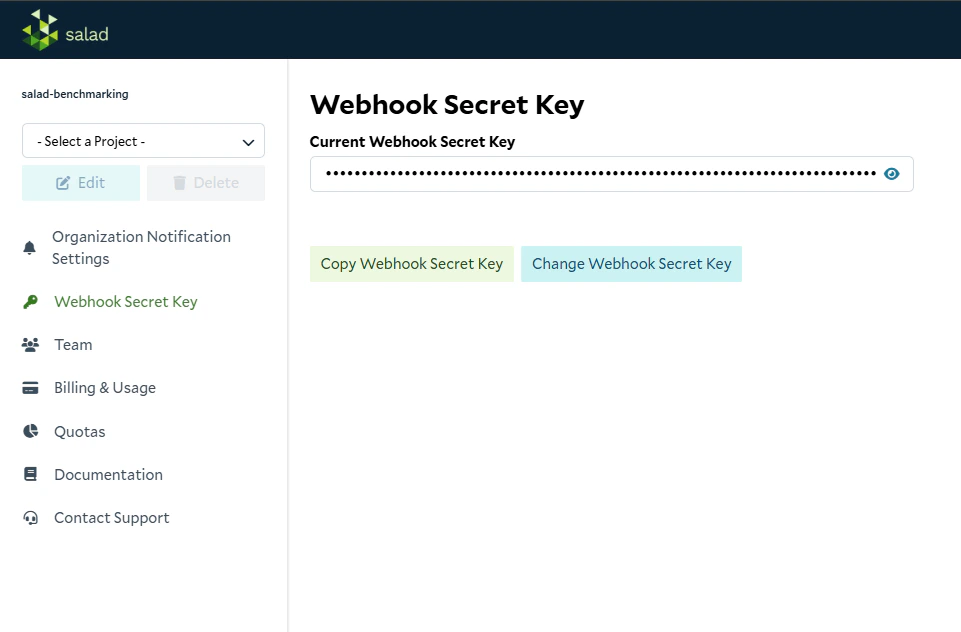
signature of the payload. This signature can be validated using your webhook secret key, available in the portal, and
the svix library.
Validating the Signature
Node.js Example
First, install svix:
Then, you can use the following code to validate the signature:
const { Webhook } = require('svix')
//Express.js middleware
function validateWebhookSignature(req, res, next) {
const webhook = new Webhook(secret)
try {
webhook.verify(req.body, req.headers)
next()
} catch (error) {
console.error('Webhook verification failed:', error)
return res.status(401).send('Invalid signature')
}
}
Python Example
First, install svix:
Then, you can use the following code to validate the signature:
from fastapi import FastAPI, Request, HTTPException
from svix import Webhook
from typing import Any, Dict
async def validate_webhook(request: Request) -> Dict[str, Any]:
"""
FastAPI Dependency to validate webhook signatures
"""
try:
# Get the raw body
body = await request.body()
# Create webhook instance
webhook = Webhook(webhook_secret)
# Verify the webhook signature
payload = webhook.verify(body, dict(request.headers))
return payload
except Exception as e:
print(f"Webhook verification failed: {e}")
raise HTTPException(status_code=401, detail="Invalid webhook signature")